• Skip to primary navigation
  • Skip to main content

Learning Bilingually

con Laura Pantin

  • HOME
  • ABOUT
    • Mission
    • YouTube Videos
    • Media
  • SERVICES
  • BLOG
  • SHOP
    • TPT
    • AMAZON BOOKS
    • FLASHCARDS
      • Cart
      • Checkout
      • My account
    • DOWNLOADABLE RESOURCES
      • Cart
      • Checkout
      • My account
  • CONTACT

Uncategorized

Hosting a Spanish Spelling Bee at Your School

December 21, 2022 by Laura Pantin

This year our school decided to host our first ever Spanish Spelling Bee. Another school in our district reached out to us that they were hosting and asked if we were interested in hosting, so myself and our ESOL Specialist took on the task to organize a Spanish Spelling in 3 weeks in our school. Here is what we did in order to have an amazing Spanish Spelling Bee event at our school:

(1) First, we received the 10-word list plust 5 bonus words that we would utilize to initially test the students and then have our winners. Our spelling bee would include dual language student participants and ESOL student participants. For our 3rd-5th Dual Language classes (2 classes per grade level), we would choose 4 students, and for the ESOL students in general education classes, we would choose 3 students per grade, for a total of 21 participants.

(2) Our 3rd, 4th (myself) and 5th grade Spanish Dual Language teachers tested our students. Then, I helped our ESOL specialist go around to the general education 3rd, 4th and 5th grade classes to test the LY/LF ESOL Spanish-speaking students. I created a schedule and we split the classes we needed to test between the two of us and had all the ESOL students tested in one week. We tested the 3rd ESOL on one day, the 4th ESOL on the next and the 5th ESOL on the third day.

(3) After checking all the written spelling tests, we found the participants who qualified. We created a family permission slip and sent it home with those students, asking them to bring it back as soon as possible. The permission slip also invited the parents to come and attend the spelling bee!

(4) After receiving the permission slips back, we emailed each participants’ parents and emailed them the National Spanish Spelling Bee Student Study Guide (http://nationalspanishspellingbee.com/) that their child could use to review/study if they wished to.

Next, we had to focus on getting together how we would run the bee and what decorations and things we needed to make this event organized and exciting!

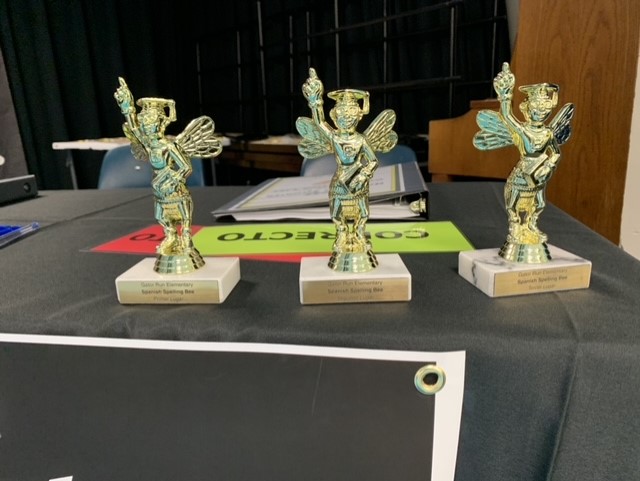
I found trophies from the K2Awards website (https://k2awards.com/) and personalized three “Standard Spelling Bee” trophies – I engraved Spanish Spelling Bee, our school name and Primer/Segundo/Tercer lugar.
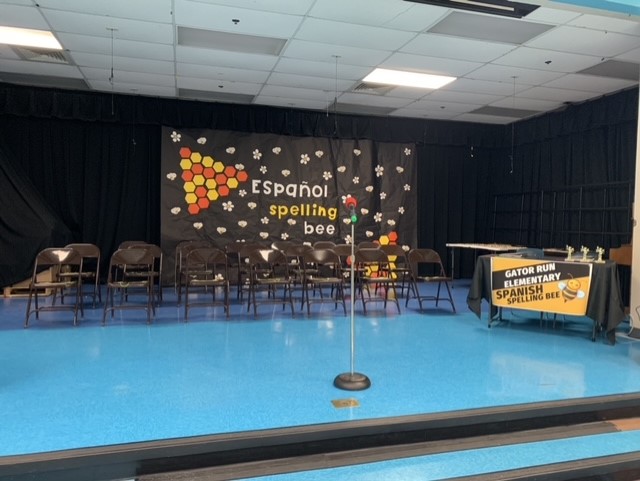
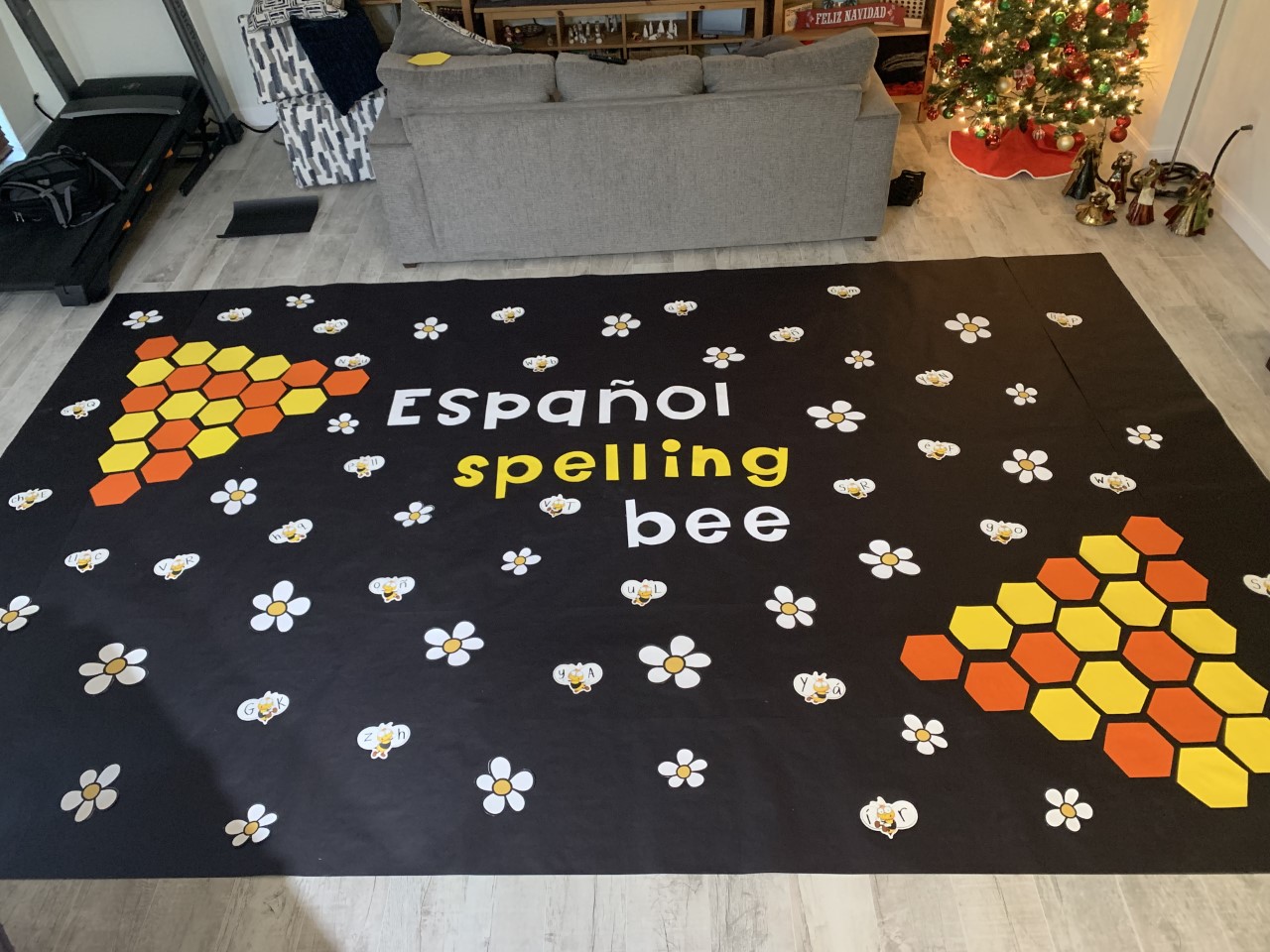
Then, I grabbed some black bulletin board paper to create a backdrop. I created some lettering on the computer and found some black/white/yellow flowers and printed them in different sizes and bought some bee cutouts from Amazon (https://a.co/d/boBTvdp). When I received the bee cutouts, I used a black sharpie to add letters to each bee wing. I used all of this to create the backdrop for our event.
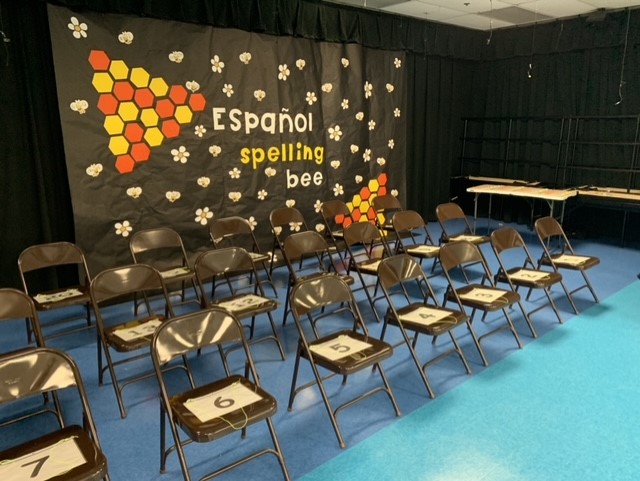
I also created number signs for numbers 1-21 for all our participants so they could wear the number sign during the bee. The day before the bee we set up the backdrop and the chairs and on each chair we placed the participant numbers (which we slipped into a transparent sleeve and added lanyard so it could be worn by each participant).
We created Judge’s Scoring Sheets and created binders for each judge (two judges) and one binder for the host (me). In the binder we also included a green “CORRECTO” sign and a red “INCORRECTO” sign for each judge that they would hold up after each participant spelled their word to indicate whether it was correct or incorrect.
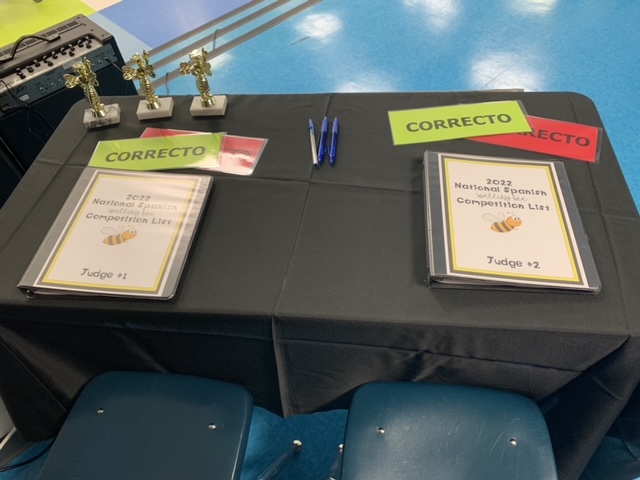
You can click here to download a copy of the Judge’s Scoring Sheet & participant #/name/grade/teacher name sheet we used to keep everything organized:

Judges-Score-Sheet-and-ParticipantsDownload

We put together the rules and regulations based on the rules and regulations from the National Spanish Spelling Bee, which you can download here:

Spanish-Spelling-Bee-Rules-in-SpanishDownload

We also decided that 3 days before the actual spelling bee we would gather all the participants in our cafeteria (where the bee would be held) and we would explain to them all the rules of the bee and show them examples so that they felt more comfortable and prepared the day of!

Finally, I created participation certificates in Spanish for each student, and we purchased bee keychains for the participants. All participants would receive the certificate and keychain, and the top Three Winners would also each receive their trophy.
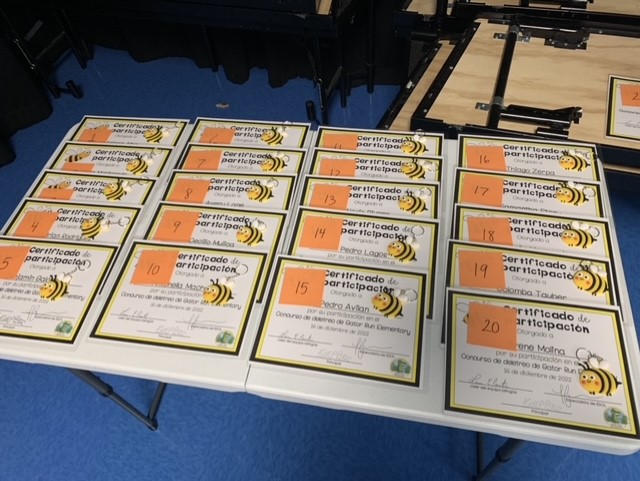
Bee keychains: https://a.co/d/19oOFKw

Bee ballons (which I went to Party City to have them blow them up for me the night before): https://a.co/d/8ecXobR & https://a.co/d/hpvMaxR

Finally, we had previously invited not only the parents of the participants to the bee, but also the 3rd-5th dual language classes and the classes of the participating ESOL students who had qualified. This ensured we had a great audience for the event and that all participants had someone supporting them!

In terms of the bee itself, after the participant said, spelled and said their word out loud and after the judges had held up the correcto or incorrecto signs, the participant had to go sit back down until the round was over. At the end of the round, the ESOL specialist grabbed the judges’ score sheet and brought it over to me. Any particicpant with an X for that round, I asked to stand up, they were given their certificate and keychain and escorted to sit down in the audience for the rest of the bee. We had the audience applaud them and the great job they had done!

We repeated this after each round until we had less and less students and continued until we had our top 3 and then our first ands second place winners!

I hope this post can help you get started to plan, organize and hold a Spanish Spelling Bee at your school! If you decide to host and there’s other schools in your zone/region that host as well, you could then do a zone/region competition between the top 2/3 winners from each school! Any specific questions about the word lists and all of that make sure to contact the National Spanish Spelling bee: nssbsa@gmail.com

Filed Under: Uncategorized Tagged With: bilingual, bilingual education, bilingualism, dual language, dual language immersion, school, spanish, spelling bee

Books for Back to School in Spanish

August 3, 2020 by Laura Pantin

En este post voy a compartir algunos de mis libros favoritos para el regreso a la escuela; libros que son diversos y tienen mensajes lindos y pueden ser utilizados para discusiones importantes en el aula.

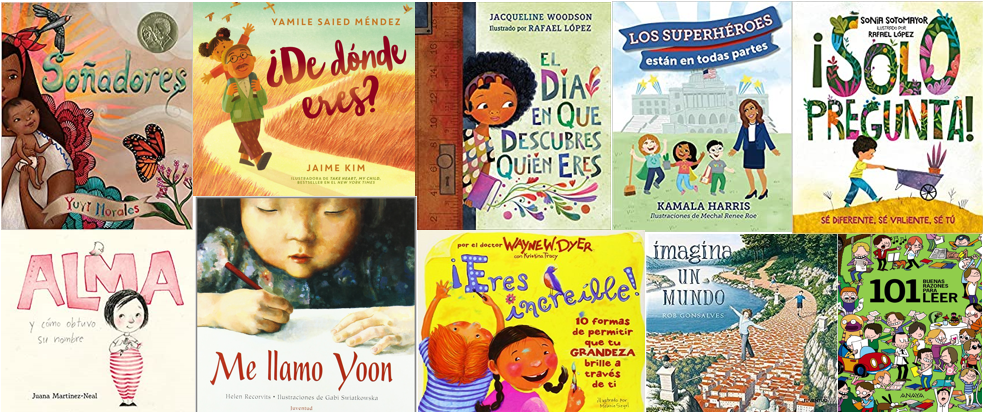
El primer libro se llama “Soñadores” que es la versión en español del libro “Dreamers” escrito por Yuyi Morales. Este libro se trata de la transición a una nueva vida en un nuevo país y realmente las ilustraciones son espectaculares. Este libro es buenísimo para utilizar al principio del ano porque puedes dejar que tus estudiantes, además de hacer conexiones con el libro y hablar sobre los temas, podrán describir como ellos mismos son soñadores del mundo.

El segundo libro se llama “¿De donde eres?” escrito por Yamile Saied Mendez. Este libro se trata de una niña que le decide preguntar a su abuela, ¿de donde soy? Ella le pregunta esto porque continuamente hay personas preguntándole “¿de donde eres de verdad?” El abuelo explica de donde son, usando lenguaje figurado y descripciones llamativas y detalladas. Este libro es perfecto para el principio del año porque quizás muchos de tus alumnos puedan conectar con esa pregunta de “¿de donde eres de verdad?” Este libro también puede ser un punto de partida para hablar de la diversidad de nuestro país y hasta en nuestra aula y tener conversaciones de identidad y cultura para conocernos y entendernos mejor.

El tercer libro se llama “El día en que descubres quien eres” escrito por Jacqueline Woodson. El libro se trata de una niña comenzando en una escuela nueva y el libro comienza con “Habrá veces en que entres a un lugar y no veas a nadie como tú” y termina la niña haciendo conexiones con otro compañero en el salón. Este libro es perfecto para el principio del ano porque describe los pensamientos y sentimientos que quizás tengan algunos de tus alumnos y puede servir como ejemplo de estar abiertos a nuevas experiencias y nuevas amistades.

El cuarto libro se llama “Los superhéroes están en todas partes” escrito por Kamala Harris. El libro se trata de la idea que los superhéroes los podemos ver todos los días, sean tus padres, sean otras personas en las cuales puedes contar con apoyo, sean personas de la historia que defienden lo que es justo, sean buenos amigos, o maestros, o personas que nos protegen, y muchos más. El libro esta narrado de la vida de la autora, y puede servir para plantear esa idea que los superhéroes son reales y no son necesariamente lo que vemos en las películas. También este libro se puede utilizar para conocer a tus alumnos mejor y preguntarles a ellos, quien es un superhéroe para ellos.

El quinto libro se llama “Solo pregunta – se diferente, se valiente, se tu” escrito por Sonia Sotomayor. Este libro se trata de varios niños que tienes habilidades diferentes y la idea de que, aunque “cada uno de nosotros crecemos a nuestra propia manera, si sientes curiosidad acerca de otros niños o personas, solo pregunta.” Creo que este libro es poderoso para el principio del ano porque les deja saber a tus alumnos que esta bien preguntar, de manera respetuosa y considerada, esas curiosidades que es natural tener. En este libro hay muchas oportunidades para hablar, discutir y hacer conexiones al mundo en que vivimos.

Los siguientes dos libros hablan sobre nuestros nombres y la importancia de nuestros nombres en nuestra identidad. El primero se llama “Alma y como obtuvo su nombre” escrito por Juana Martínez-Neal. El libro se trata de una niña, Alma Sofia Esperanza José Pura Candela, y como a veces ella se pregunta porque tiene un nombre tan largo. Ella habla con su papá, quién le cuenta la historia detrás de cada uno de sus nombres. A través del cuento ves que cada parte de su nombre forma una parte especial y única de su identidad.

El segundo libro se llama, “Me llamo Yoon” escrito por Helen Recorvits. Este libro se trata de una niña Yoon, que emigró de su país Corea a otro país y cuando tuvo que escribir su nombre usando las letras en vez de los símbolos que se usan en coreano, no le gustaba. En el libro ves que no quiere escribir su nombre en la escuela, pero comienza aprendiendo palabras para escribir, como gato y pájaro. Hasta que al final se siente cómoda y orgullosa de escribir su nombre en español también usando las letras, pero que al final ella sabe que significa lo mismo en ambos idiomas y es igualmente bello en ambos idiomas.

Estos dos libros son buenos para leer al principio del año porque se trata de como nos identificamos y como nos sentimos con nuestros nombres. Estos libros ayudarían a tener conversaciones sobre el significado de los nombres de nuestros estudiantes, asegurarnos que estemos diciendo los nombres correctamente y si no, darles una oportunidad a los alumnos corregirnos y también hablar sobre nuestras identidades.

También me gustan estos dos libros para el principio del año porque ayudan a transmitir esa mentalidad positiva y imaginativa. El libro “¡Eres increíble! 10 formas de permitir que tu grandeza brille a través ti” escrito por Doctor Wayne W. Dyer habla de 10 formas donde los niños pueden trabajar en esa mentalidad positiva y podría abrir las puertas para hablar con nuestros estudiantes de como se ve eso y cómo podríamos implementar estas 10 estrategias en nuestro salón y en nuestras vidas. Y el próximo libro es “Imagina un mundo” por Rob Gonsalves y has otros libros en la serie “imagina…” o “Imagine” y es un libro de poesía donde desafía al lector imaginar un mundo más allá de lo que vemos y hacemos. Por ejemplo, en una pagina dice “Imagina un mundo…donde el desafío de enfrentarse a un mar embravecido es también oportunidad para alcanzar el pico mas alto.”

Y este último libro no es uno que necesariamente lo voy a leer como una lectura en voz alta en un día. El libro se llama “101 buenas razones para leer” de la publicación Anaya. Es chistoso y ofrece 101 razones por la cual es buenísimo leer, y me gusta para alentar a mis estudiantes que piensen en las razones por las cuales a ellos les gusta leer a ellos.

Filed Under: Uncategorized

My Favorite YouTube Channels in Spanish

July 25, 2020 by Laura Pantin

I think that quality videos are a great instructional tool for our dual language learners. It’s also important to continuously find ways to get that comprehensible input and lower our children’s anxiety in the language classroom. I have utilized quality YouTube videos in both my Kindergarten Dual Language and 4th Grade Dual Language classrooms to either introduce a topic, have students take notes/further learn about a topic or use as a reference for additional information on a topic. In this post I’m going to share some of my favorite YouTube channels that I utilize with my own students. Some of these channels are more geared for our younger emerging bilingual students and others are more geared for our intermediate emerging bilingual students.

First, I will share some of my favorite channels for our young dual language learners. These channels are vivid images and are very captivating for our young emerging bilingual children!

  • Doremi: https://tinyurl.com/y6ks3dfr
  • ToyCantando: https://www.youtube.com/user/toycantando
  • Lunacreciente: https://www.youtube.com/user/lunacreciente
  • El Reino Infantil: https://www.youtube.com/user/ReinoMariaElenaWalsh
  • El Reino a Jugar: https://tinyurl.com/y6o32vug
  • Guiainfantil: https://www.youtube.com/user/guiainfantil
  • Cosas de Peques: https://www.youtube.com/user/MrCosasdepeques
  • T-Series Kids Hut- Cuentos en Español: https://www.youtube.com/user/kidshut
  • Vamos a la Biblio: https://tinyurl.com/y54ks3f5
  • Calico Spanish for Kids: https://www.youtube.com/user/kidsimmersion


Next, I will share some of my favorite channels for our intermediate dual language learners or older students! These videos have great content and explanations for our intermediate learners and can be used to frontload information or for further reference on a topic!

  • Happy Learning Español: https://tinyurl.com/y537e892
  • CNTV Infantil: https://www.youtube.com/user/NovasurTV
  • Smile and Learn – Español: https://tinyurl.com/yxt6cnfr
  • Jesús Chacón Chaparro: https://www.youtube.com/user/Kaervekkun
  • Elesapiens: https://www.youtube.com/user/Kaervekkun
  • Tio Spanish: Aprender español online: https://www.youtube.com/user/TioSpanish
  • Aula365-Los Creadores: https://www.youtube.com/user/aula365tv
  • La Eduteca: https://www.youtube.com/user/lavideoeduteca
  • Matecitos: https://tinyurl.com/y4nhwmew
  • The Gust: https://tinyurl.com/y3n72y39
  • Daniel Carreon: https://www.youtube.com/user/JAKEMATHE1
  • La Profe Noemí: https://tinyurl.com/y3t2dus7

Filed Under: Uncategorized

Before Footer

Copyright © 2026 · Wellness Pro on Genesis Framework · WordPress · Log in